Manual Whirlpool W8F HS61W Máquina de lavar louça

Precisa de um manual para o seu Whirlpool W8F HS61W Máquina de lavar louça? Abaixo você pode visualizar e baixar gratuitamente o manual em PDF em português. Este produto tem atualmente 12 perguntas frequentes, 0 comentários e tem 0 votos. Se este não for o manual que você deseja, por favor contacte-nos.

Seu produto está com defeito e o manual não oferece solução? Vá a um Repair Café para obter serviços de reparo gratuitos.

Manual

Loading…
EN
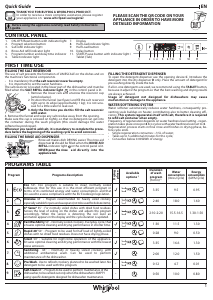
Daily Reference Guide
2
ADVICE REGARDING THE FIRST TIME USE
After installation, remove the stoppers from the racks and the retaining
elastic elements from the upper rack.
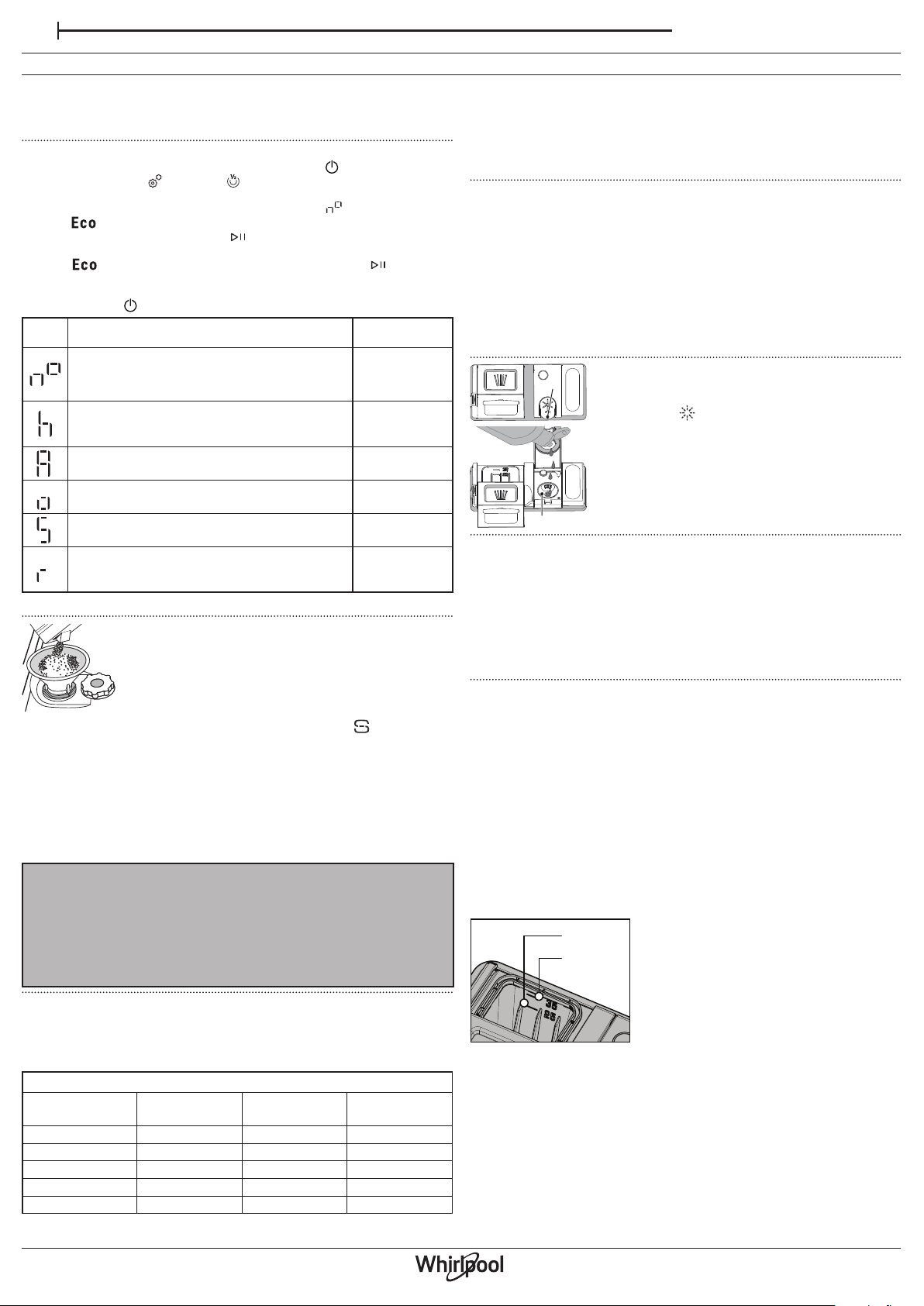
SETTING MENU
1. Switch on the appliance by pressing the ON-OFF button.
2. Hold the Settings (Half Load ) button for 3 seconds until you hear
a beep.
3. After one second the rst available setting (letter ”) will be displayed.
4. Press button to scroll through the list of available settings (see table
below), then press START/Pause to view and change the value of the
currently selected setting.
5. Press to change the value, then press START/Pause to save the
new value.
6. To change another setting, repeat points 2 and 5.
7. Press ON-OFF or wait 30 seconds to exit the menu.
LETTER
SETTING
VALUES
(Default - in bold)*
Cycle Counter - number of washing cycles
carried out by the dishwasher.
Eg. 25 cycles: 25;
Eg. 13.947 cycles:
13_947
(scrolling
for 3 times)
Water Hardness Level
(see “SETTING THE WATER HARDNESS” and “WA-
TER HARDNESS TABLE”)
1 | 2 | 3 | 4 | 5
Rinse Aid Level
(see “ADJUSTING THE DOSAGE OF RINSE AID”)
0 | 1 | 2 | 3 | 4 | 5
NaturalDry (see “OPTIONS AND FUNCTIONS”)
“1” = On, “0” = O
1 | 0
Sound
“1” = On, “0” = O
1 | 0
Factory Settings - press START/Pause to re-
store to the factory default all the values of the
settings included in the settings menu.
-
*) The default value does not apply to the Cycle Counter.
FILLING THE SALT RESERVOIR
The use of salt prevents the formation of LIMESCALE on
the dishes and on the machines functional components.
The salt reservoir is located in the lower part of the dish-
washer (under the lower rack on the left side).
It is mandatory that the salt reservoir never be empty.
It is important to set the water hardness.
Salt must be lled when the SALT REFILL indicator light on the control
panel is lit.
1. Remove the lower rack and unscrew the reservoir cap (anticlockwise).
2. Position the funnel (see gure) and ll the salt reservoir right up to its
edge (approximately 0,5 kg); it is not unusual for alittle water to leak out.
3. Only the rst time you do this: ll the salt reservoir with water.
4. Remove the funnel and wipe any salt residue away from the opening.
Make sure the cap is screwed on tightly so that no detergent can get into
the container during the wash program (this could damage the water sof-
tener beyond repair).
Whenever you need to add salt, it is mandatory to complete the pro-
cedure before the beginning of the washing cycle to avoid corrosion.
Residual saline solution or grains of salt can lead to corrosion, irrep-
arably damaging the stainless steel components.
The guarantee is not applicable if faults are caused by such circumstances.
If the salt container is not lled, the water softener and the heating
element may be damaged as a result of limescale accumulation.
Using of Salt is recommended with any type of dishwasher detergent.
SETTING THE WATER HARDNESS
To allow the water softener to work in a perfect way, it is essential that the
water hardness setting is based on the actual water hardness in your house.
This information can be obtained from your local water supplier. The facto-
ry setting is 3”. See WATER HARDNESS TABLE”.
Water Hardness Table
Level
°dH
German degrees
°fH
French degrees
°Clark
English degrees
1 (Soft) 0 - 6 0 - 10 0 - 7
2 (Medium) 7 - 11 11 - 20 8 - 14
3 (Average) 12 - 16 21 - 29 15 - 20
4 (Hard) 17 - 34 30 - 60 21 - 42
5 (Very hard) 35 - 50 61 - 90 43 - 62
To change, follow instructions in section “SETTING MENU”.
Only use salt that has been specically designed for dishwashers.
After the salt has been poured into the machine, the SALT REFILL indicator
light switches o.
If the salt container is not lled, the water softener and the heating
element may be damaged as a result of limescale accumulation.
Using of Salt is recommended with any type of dishwasher detergent.
WATER SOFTENING SYSTEM
Water softener automatically reduces water hardness, consequently pre-
venting scale buildup on the heater, contributing also to better cleaning ef-
ciency. This system regenerates itself with salt, therefore it is required
to rell the salt container when empty.
The frequency of regeneration depends on the water hardness level setting
- regeneration takes place once per 4-6 Eco cycles with the water hardness
level set to 3. The regeneration process occurs at the beginning of the cycle
with additional fresh water.
Single regeneration consumes ~3 L of water;
Takes up to 5 additional minutes for the cycle;
Consumes below 0.005kWh of energy.
A
B
FILLING THE RINSE AID DISPENSER
Rinse aid makes dish DRYING easier. The rinse aid dis-
penser Ashould be lled when the RINSE AID REFILL
indicator light in the control panel is lit.
1. Open the dispenser B by pressing and pulling up
the tab on the lid.
2. Pour in the rinse aid (max. 110 ml), making sure it
does not overow from the dispenser. If this hap-
pens, clean the spill immediately with adry cloth.
3. Press the lid down until you hear aclick to close it.
NEVER pour the rinse aid directly into the appli-
ance tub.
ADJUSTING THE DOSAGE OF RINSE AID
If you are not completely satised with the drying results, you can adjust
the quantity of rinse aid used.
To change, follow the instructions in the section “SETTING MENU”.
If the rinse aid level is set to ZERO, no rinse aid will be supplied. The LOW
RINSE AID indicator light will not be lit if you run out of rinse aid.
A maximum of 6 levels can be set according to the dishwasher model.
If you see bluish streaks on the dishes, set a low number (0-3).
If there are drops of water or limescale marks on the dishes, set a mid-
range number (4-5).
FILLING THE DETERGENT DISPENSER
Only use detergent which has been specically designed for dishwashers.
DO NOT USE washing up liquid.
Using excessive detergent may result in foam residues remaining in
the machine after the cycle has ended.
Usage of detergent not designed for dishwashers may cause malfunc-
tion or damage to the appliance.
To achieve the best washing and drying results, the combined use of
detergent, rinse aid liquid and rened salt is required.
We recommend using detergents that do not contain phosphates or
chlorine, as these products are harmful to the environment.
Good washing results also depend on the correct amount of detergent
being used.
Exceeding the stated amount does not result in a more eective wash
and increases environmental pollution.
25 ml
35 ml
The amount can be adjusted to the soil lev-
el. In the case of normally soiled items, use
approximately either 35g (powder deter-
gent) or 35ml (liquid detergent) and addi-
tional tea spoon of detergent directly in-
side the tub. If tablets are used, one tablet
will be enough.
If the crockery is only lightly soiled or if
it has been rinsed with water before be-
ing placed in the dishwasher, reduce the
amount of detergent used accordingly (minimum 25 g/ml) e.g. skip the
powder/gel putted inside the tub.
For good washing results also follow the instructions shown on the
detergent box.
For further questions please ask the detergent producers.
FIRST TIME USE
Descarregue o manual em português (PDF, 72.56 MB)
(Considere o meio ambiente e apenas imprima este manual se for realmente necessário)

Loading…

Avaliação

Deixe-nos saber o que você pensa sobre a Whirlpool W8F HS61W Máquina de lavar louça, deixando uma classificação do produto. Quer compartilhar suas experiências com este produto ou fazer uma pergunta? Por favor, deixe um comentário na parte inferior da página.
Você está satisfeito com Whirlpool W8F HS61W Máquina de lavar louça?
Sim Não
Seja o primeiro a avaliar este produto
0 votos

Participe da conversa sobre este produto

Aqui você pode compartilhar o que pensa sobre Whirlpool W8F HS61W Máquina de lavar louça. Se você tiver alguma dúvida, primeiro leia atentamente o manual. A solicitação de manual pode ser feita através do nosso formulário de contato.

Mais sobre este manual

Entendemos que é bom ter um manual em papel para o seu Whirlpool W8F HS61W Máquina de lavar louça. Você sempre pode baixar o manual em nosso site e imprimi-lo você mesmo. Se desejar um manual original, recomendamos que entre em contato com Whirlpool. Eles podem fornecer um manual original. Você está procurando o manual do seu Whirlpool W8F HS61W Máquina de lavar louça em outro idioma? Escolha o seu idioma preferido em nossa página inicial e pesquise o número do modelo para ver se o temos disponível.

Especificações

Marca Whirlpool
Modelo W8F HS61W
Categoria Máquinas de lavar louça
Tipo de arquivo PDF
Tamanho do arquivo 72.56 MB

Todos os manuais para Whirlpool Máquinas de lavar louça
Mais manuais de Máquinas de lavar louça

Perguntas frequentes sobre Whirlpool W8F HS61W Máquina de lavar louça

Nossa equipe de suporte pesquisa informações úteis e respostas a perguntas frequentes sobre produtos. Se você encontrar algum dado incorreto em nossas perguntas frequentes, informe-nos usando nosso formulário de contato.

Mesmo depois da minha lava-louças terminar o seu ciclo, o recipiente que contém a pastilha não havia aberto. Como isso é possível? Verificado

Este problema muitas vezes é causado por pratos que bloqueiam o recipiente. Verifique isto antes de ligar o lava-louças.

Isso foi útil (8379) Consulte Mais informação

A máquina de lavar loiça não aquece mais a água. Por que? Verificado

É provável que o elemento aquecedor esteja com defeito. Substitua-o. Em caso de dúvida, entre em contato com o fabricante.

Isso foi útil (8167) Consulte Mais informação

Posso usar sal comum na minha máquina de lavar louça? Verificado

Não, o sal comum pode conter substâncias que podem causar danos ao seu aparelho.

Isso foi útil (3474) Consulte Mais informação

Preciso enxaguar meus pratos antes de colocá-los na máquina de lavar loiça? Verificado

Não é necessário enxaguar os pratos, mas é necessário remover quaisquer restos grandes, duros e gordurosos. Isso pode entupir o dreno com o tempo.

Isso foi útil (1430) Consulte Mais informação

Posso abrir a máquina de lavar louça enquanto ela está funcionando? Verificado

A maioria das máquinas de lavar louça está equipada com um sistema de interrupção de água, fazendo com que o programa pare imediatamente quando a porta for aberta e não haverá saída de água. Com alguns modelos, isso pode causar problemas ao longo do tempo. Com as máquinas de lavar louça embutidas, é possível que a abertura frequente da máquina de lavar louça durante o funcionamento possa causar danos por água aos armários circundantes devido ao vapor libertado.

Isso foi útil (1216) Consulte Mais informação

Devo abrir a máquina de lavar louça depois de terminar de funcionar para que a louça seque mais rápido? Verificado

Isso depende do tipo e da localização da máquina de lavar louça. Algumas máquinas de lavar louça estão equipadas com um recurso que seca a louça após o programa de lavagem. Nesse caso, abrir a máquina de lavar louça não terá valor acrescentado. Com as máquinas de lavar louça embutidas, é possível que a abertura frequente da máquina de lavar louça durante o funcionamento possa causar danos por água aos armários circundantes devido ao vapor libertado.

Isso foi útil (973) Consulte Mais informação

O que significa '6º sentido'? Verificado

Os aparelhos Whirlpool equipados com a tecnologia 6th Sense possuem sensores que garantem o funcionamento ideal da máquina. Por exemplo, em secadoras, esses sensores medem a umidade deixada na lavagem e param a máquina quando tudo está completamente seco.

Isso foi útil (902) Consulte Mais informação

Depois de a máquina de lavar louça terminar o ciclo, os pratos de plástico ainda estão molhados, mas o resto não. Por que é que? Verificado

O plástico é um mau condutor de calor, permitindo que os produtos esfriem rapidamente. A umidade que permanece nele evapora muito menos do que, por exemplo, em cerâmica ou metal.

Isso foi útil (870) Consulte Mais informação

Posso conectar uma máquina de lavar louça a um cabo de extensão? Verificado

Os aparelhos que requerem grande quantidade de energia, como uma máquina de lavar louça, não podem ser conectados a todos os cabos de extensão. Veja qual é o consumo de energia da máquina de lavar louça, que é indicado em Watt, e verifique se o cabo de extensão pode suportar isso. Existem cabos de extensão com cabos mais grossos que são feitos para lidar com aparelhos maiores.

Isso foi útil (816) Consulte Mais informação

Posso colocar panelas com Teflon na máquina de lavar louça? Verificado

Sim você pode. No entanto, a frigideira vai se desgastar mais rapidamente do que quando é limpa à mão. Ao limpar uma panela com Teflon à mão, nunca use um esfregão, mas use uma esponja ou pano macio.

Isso foi útil (814) Consulte Mais informação

Posso colocar objetos de madeira, como espátulas e tábuas de cortar, na máquina de lavar louça? Verificado

Não. Objetos de madeira podem ser danificados ou empenados na máquina de lavar louça. Além disso, as fibras de madeira que se soltam podem danificar a máquina de lavar louça. As tábuas de corte de madeira geralmente são feitas com cola que pode se soltar após várias vezes na máquina de lavar louça.

Isso foi útil (812) Consulte Mais informação

É um problema ter arranhões no metal no interior da máquina de lavar louça? Verificado

O interior da maioria das máquinas de lavar louça é feito de aço inoxidável e não é afetado por arranhões.

Isso foi útil (811) Consulte Mais informação
Manual Whirlpool W8F HS61W Máquina de lavar louça

Produtos relacionados

Categorias relacionadas

×
Download